My time in Laos was relatively short (six-and-a-half weeks), but still I experienced many great and adventurous moments! Nevertheless, there
When coming to landlocked Laos, you probably would not expect to meet Laotians who speak German – but quite a
My special task during our stay in Laos was to spruce up the English Lending Library. Establishing the Lending Library
Mit and Noy are two of the four Lao English teachers who received a voucher from the Angel for Children
Thanks to the exemplary work of everybody involved, our project has grown fast, both in scope and influence. Therefore, we
Lathsamy Chanthavongsa is an English teacher at Phang Heng Primary School, teaching Preschool class 1 and classes 3-5. For the last
Knowing that I sometimes travel to Southeast Asia, Prof. Martin told me about the "Teaching English in Laos" project. An
Shortly before our departure, our second workshop took place. It targeted the problem of the limited number of methods used
We continue the work at the schools started by Team I but also carry on their special tasks (see article
International Women's Day sometimes goes almost unnoticed in Germany or Western Europe. Here in Laos it marks a public holiday,
The project “Teaching English in Laos” aims to sustainably foster English education in Laos. Therefore, teaching the Lao pupils is
At about 20 minutes' driving distance from Sikeud a quiet and not very touristic elephant farm is located. Johannes kindly

Project videos

Ban Sikeud primary school

The first school supported by the foundation since 2003

Ban Phang Heng lower secondary school

Lower secondary school, supported by Angels for Children since 2011

Ban Phang Heng primary school

Second primary school supported by the foundation since 2013

Lao-German Technical College

Joint vocational training with BHS Corrugated since 2015

Savannakhet University

University cooperation between Savannakhet and Karlsruhe since 2018

Vocational Education Development Institute

Cooperation between the VEDI and  the University of Education Karlsruhe since 2019

Sunshine school

Cooperation between the Sunshine school and  the University of Education Karlsruhe since 2020

Literature

Academic literature on Laos
– Education
– Vocational training
– Miscellaneous

News

Please subscribe to our blog for new blog posts, events, photos and videos! Stay tuned!

Contact us

– Questions, comments, suggestions?
– Joining, helping, or donating?
– Send a message!

© 2021 University of Education Karlsruhe. All rights reserved.

My personal highlight – by Isabella Stryj

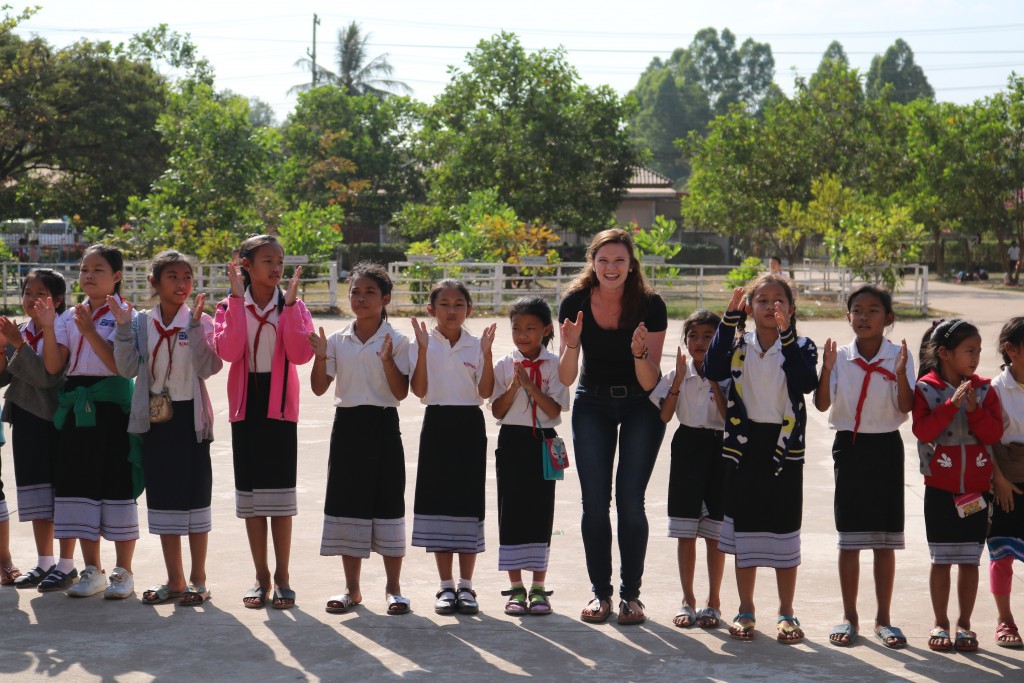
My time in Laos was relatively short (six-and-a-half weeks), but still I experienced many great and adventurous moments! Nevertheless, there is one memory that makes me smile whenever I think of it:

Jule and I took Chanhpasong, Noy and Sackbong, three of the non-English teachers from Sikeud Secondary School on a day trip to Nam Ngum. Nam Ngum is a water reservoir located a 2-hour motorbike ride away north of Ban Sikeud. When we arrived at the boat terminal, Noy told me that he had never been on a boat before! When I asked him whether he was scared he said that he was very excited. Since the young teachers don’t have much money, we invited them on a boat cruise.Nam Ngum

As we left the harbor the three young men were sitting opposite us and smiling from ear to ear like little boys. Seeing them so happy and joyful made me very happy. A moment I will definitely never forget.

We had lunch on the boat – fish, fried rice, morning glory, fried vegetables and of course beer Lao. The first stop was on a little island where we went tubing in the lake. What fun we had plunging in the water like little children! Fortunately all of them could swim.

Back on the boat we had our private party going with loud Lao music roaring from the speaker. Our captain – a 20-year old man – set course for a panorama platform, from which we had a great view over the lake with all its little islands and the dam.

The 3-hour boat trip did not cost much but gave us a joyful and memorable time.Nam Ngum

Text & photos by: I. Stryj

The Lao German Technical College – a new partner school for “Teaching English in Laos”

When coming to landlocked Laos, you probably would not expect to meet Laotians who speak German – but quite a few do! You may not know that Germany and Laos have had a long-lasting relationship: in 2016 the Lao-German Friendship Association celebrated the 58th anniversary of diplomatic relations between both countries since 1958.

One of these connections exists between the Angels for Children foundation and the Lao German Technical College (LGTC) in Vientiane, whose director Mr Somlith Virivong speaks fluent German. On hearing about the foundation’s new project “Teaching English in Laos”, he invited the project management to visit the LGTC on 2 November 2015 to discuss the dire need for English in vocational training institutions (cf. “Timeline”).

During Christian Engel’s and Prof. Martin’s second visit in December, a “Memorandum of Understanding” was not only signed between the foundation and the University of Education Karlsruhe to promote English learning, but also between the Engel family firm BHS Corrugated and the LGTC to improve vocational training. To manage the latter, Mr Bernhard Fuerst, who is the Chairman of the Bavarian Regional Association of  Master of Industries (and a Bachelor Professional of Metal Production Technology and Operations (CCI) as well as an experienced trainer in vocational schools), had been invited to acquaint himself with the place, and he decided soon after to commit to the project. He is now in charge of the introduction of the “Dual Cooperative Training” that is a German speciality, which starts with special training courses in September 2016.

The idea to combine both cooperations and to implement the “Teaching English in Laos” programme at the College as well seemed a natural conclusion: The College students, too, need better English skills for better chances on the ASEAN job market, and many international firms are waiting for a better trained work force to open up new businesses and factories in Laos, which, in turn, would create new jobs.

So, the project management and the LGTC decided that from September 2016 on, Prof. Martin would be accompanied by two additional volunteers from the University of Education Karlsruhe to start the “teach-the-teacher” programme at the College. This means designing a tailor-made in-service teacher training syllabus after model-teaching and tandem-teaching some classes, and then also offering workshops in English language proficiency, modern foreign language didactics and methodology. Supporting the trainers in revising or updating their teaching materials will also be part of their tasks, and of course they will report on their work in this blog, too!

On a larger scale, as with the other three schools supported by Angels for Children, the new programme at the Lao German Technical College is to serve as a role model for other vocational training schools or colleges regarding the improvement of both vocational training and standards in English proficiency. And indeed, the directors of several other vocational training colleges, who were present during the second meeting in December, have already approached the project management with their own request of support. They would like to offer in-service training in the English language and foreign language didactics to their teaching staff as well.

Historical background: In 1975 both German states opened embassies in Vientiane. After German reunification, the embassy of the Federal Republic of Germany joined the former embassy of the German Democratic Republic, which is now the current embassy of Germany in Laos, with His Excellency Mr Michael Grau as Ambassador. Although the German Democratic Republic was dissolved in 1990 and had only been active in Laos for 15 years, it had had a major impact on the country. In the name of “cooperation with socialist brother states” more than 3,000 young Laotians were trained in Eastern Germany, mainly in the technical and vocational field. After returning to Laos with a high-quality education and German language proficiency, many of them made their way to high ranks in politics and economy. Seven ministers and vice-ministers of the present Lao government studied or received vocational training in the German Democratic Republic, just like the director of the LGTC, our new partner Mr Somlith Virivong. Another noteworthy example is the Vice Minister of Education, Prof. Dr. Kongsy Sengmany, who studied physics in Dresden (and came to visit our schools in January 2016).

The Lao German Technical College in Vientiane is a vocational training school under the Ministry of Education and Sports and a manifest part of the ties with Germany. It was established in 1964 as the “Lao-German Vocational Secondary School” with German support and has changed its name over the years more than once. In 2015 the “Lao German Technical School” received College status.

Currently around 1,000 students attend the College, which offers six main branches of vocational training: Automotive technology, metal machining, electro-electronics, welding-plumbing, heavy-equipment, and agro-machinery.  The College offers different paths of traineeships with several curriculum models, such as the 9+3 or 12+2 model (9 or 12 years education in school, with 3 or 2 years’ vocational training). The school is thus open to all kinds of graduates: Lower secondary graduates, high school graduates, and university graduates. Thanks to its long connection with Germany, the Lao German Technical College is the perfect place to instal the “Dual Cooperative Training” approach in Laos, which combines vocational education in schools or colleges with in-service training in companies.

In 2012 and 2013 the College was renovated and equipped with new machines by the German “KfW”, especially in the field of electrics. More and more companies in Laos, mainly in Vientiane, are cooperating with the College to use its high-level infrastructure and equipment to train their own staff within the schools facilities. Companies like Toyota and RMA train automotive mechanics for their subsidiaries in Laos; mining companies like Phu Bia Mining train heavy machinery mechanics for their mining business in Northern Laos, and the mining company MMG trains employees for welding; Nam Theun 2 Power, one of the biggest companies for hydropower plants, uses the electrics department at the College to do in-service training for their staff – just to name a few.

Involving international companies contributes to taking the vocational traineeships to a global level, which brings us back to the field of English. Within the Free-Trade Agreement of the ASEAN Economic Community launched in 2016, English is becoming increasingly significant as a common language within the ASEAN states – not only in politics or education in schools, but also in vocational education. Due to its strategic position in the mainland of South-East Asia, Laos has the chance to secure an integral part of supply chains throughout Asia now, which would be a huge contribution to the country’s economic development. To reach this goal, Laos needs English.


Text & Photos by J. Zeck

Team II: Jana expands the Lending Library

My special task during our stay in Laos was to spruce up the English Lending Library. Establishing the Lending Library is a sustainable way to support the Lao English teachers in improving their proficiency in teaching English as a foreign language: At the Lending Library, the teachers can borrow plenty of material for their classrooms, but also a great variety of items to study the English language for themselves as well as didactic material for teaching English as a foreign language (TEFL).
Therefore we brought 2  more suitcases filled with books from Germany, which were generously donated by private persons this time.
When I saw the Lending Library for the first time I was shocked. I had seen a picture of Franziska standing in front of the well-structured and organized new library, which flashed up in my mind. The library I was standing in front of did not bear any likeness to the library in the picture. Somehow it was good to realise that the teachers had obviously made use of the material, but it looked like they had not put the books back to the right spot. It was, regrettably and quite frankly, a mess.
Consequently, I spent many hours in the office to rearrange the library and sort the books by topics. I made little signs which I stuck on the shelves so it would be easier for the teachers to find books and to return them to their spots. The monotonous work was sweetened by the curious glances of the Laotian pupils. When I started laminating some picture books for the library, the children were so fascinated that they spent hours watching me with wide eyes.

 
After six weeks of work I wondered how many English teachers actually made use of the Lending Library and borrowed books on a regular basis.
Hence, I prepared a little questionnaire for the teachers to evaluate the current use.
Here is what I asked and found out:
Do you read in your free time?
All the teachers answered the question with: Yes, I do.

How often do you read?
Most of the teachers claim to read up to 3 or 4 times a week, which is quite a lot in my opinion when you consider that they often have to do a lot of other things after school, like cooking or working on the rice fields.

How long do you read?
The answer varied in length. Some teachers only read 10 minutes when they hold a book in their hands, others read up to 1 hour.

Do you read English books?
Again all the teachers answered the question with: Yes, I do.

What is your favourite book?
All English teachers seem really interested in love stories. I can imagine this because the people in Laos love to hear Laotian music. The songs they listen to often deal with a broken heart, unrequited love, or endless love.
They also like to read funny stories such as comics, picture books and books of Disney movies.

Have you ever borrowed a book from the Lending Library or any other library?
Only the teachers from the primary school borrowed books from the Lending Library. The teachers from the secondary school either borrowed books from another library or bought books themselves. (This may be due to the fact that the secondary school is a little further away or that the teachers did not fully understand Franzi’s explanation that they, too, can use the Lending Library – Franzi had given all the teachers a guided tour to the library on the day Team I said good-bye in a little farewell ceremony.)

As you can see, all of the English teachers are interested in reading and also interested in reading English books, which is really good as they are all eager to improve their English skills. Keeping up the good work at the Lending Library and expanding it is a worthwhile task, as the teachers benefit from it.
The 7 weeks of Team II’s voluntary work are over, and we have made it safely back to Germany. Therefore, making the English Lending Library more accessible or attractive for the secondary school teachers will be a new goal for our next team. And again, donations for the Lending Library are more than welcome!

Text by: J. Brecht

Photos by: J. Reissig

Mit and Noy write: Our expectations of the stay in the UK

Mit and Noy are two of the four Lao English teachers who received a voucher from the Angel for Children foundation to attend an English language course in the UK in the summer of 2016. Congratulations once more!
We will never forget your faces when you heard the unexpected news.
Project leaders Johannes Zeck and Prof. Martin handed over the vouchers in a little Awards Ceremony on the last day of the first project phase (6 January 2016), in the presence of Team I and all the 25 Lao teachers who had attended English lessons in the preceding two months.
After their return to Germany, Prof. Martin researched language schools in Britain and finally settled a good deal with a very promising school, Hilderstone College in Broadstairs (Kent), after which Johannes took over to take care of the organisation of this new enterprise – work-in-progress.

Update (18 May 2016): As it turns out after a few months of intensive planning and preparation, it has not been possible to obtain passports for our four teachers by mid-May. This means we miss the British Embassy’s opening day and deadline for a VISA for a stay in the UK starting at the end of June. This means the trip has to be postponed by an entire year.
We would still like to share Mit and Noy’s thoughts with you about their expectations.

One task during the teacher lessons with Team II was for Mit and Noy to write down their expectations regarding their upcoming stay in England. Here is what they wrote:

Mittaphone “Mit” SichampaMit

When I have good chance to go to England, I’m very happy and very proud. So when I arrive to England I expectation with people in England they will be friendly with me and I can communication with them. And during I stay there I hope my English will improve and my pronunciation will be right when I say and talk with them. One thing I expectation I want speak English well and I want to be good teacher in the future. But I afraid about live and food. I ‘m not sure I can eat they food and live with them. And one thing I worry is about the weather because I heard the weather over there is cold. So, I’m worry. However I will try and fight for my work. Finally I wish to meet good people, good friend and I wish everything all best in my life during I stay there.

Phovang “Noy” Inthavong

Noy

In my expectations when I go to England I hope study in the school because I can talk a little bid to you. I want to speak well. I also need to improve my knowledge and pronunciation better and experience. Finally I want study with people England but I feel fears I hear some people said I live with house people. I worry her house is not good kind. I don’t know they are. I don’t know anything they like and don’t like and I worry because I never go to England and I don’t know people over there finally because Lao and England different a lot.

Text and photos: J. Brecht

6 May 2016: Start of new project phase

Thanks to the exemplary work of everybody involved, our project has grown fast, both in scope and influence. Therefore, we have agreed to help develop two new fields of work as from September 2016 which are directly related to and co-funded by the Foundation and will influence future job & life prospects of our pupils.
1. The new physics/chemistry laboratory in Ban Phang Heng middle school
2. The Lao German Technical College (LGTC) in Vientiane
Due to this extension, we have increased the places for internships from 5 to 9. (Additionally, it may be possible to offer internship places at a private school in Vientiane, under somewhat different conditions.)

A good number of applications have been submitted, and we will post documents for new interns (orientation, information, check lists, official documents etc.) on our blog soon.The deadline for applications is 1 May.

Applicants please note that the date for the interviews for internships starting in September 2016 (Team III) had to be shifted to 6 May.
We look forward to getting to know you better soon!

Isabel Martin & Johannes Zeck


"Thanks for the flowers!"
“Thanks for the flowers!”

Text by I. Martin
Photo by T. Mayer

An Interview with Lathsamy Chanthavongsa by Isabella Stryj

Lathsamy Chanthavongsa is an English teacher at Phang Heng Primary School, teaching Preschool class 1 and classes 3-5. For the last six-and-a-half weeks we got to know each other quite well and it was a pleasure to work with her. During our time together there were some questions about her life and profession that really interested me.

Now I would like to share her answers with you.

Please introduce yourself!
My name is Miss Lathsamy. I am 28 years old. I live in Nongyao Village, District Naxaython.

Why and how did you become an English teacher?
Because I like and want to know to talk English. When I teach I want student they can write and can read, talk English well.
When I come a teacher I went to studies 3 year ago. I studies at Bankeun college. When I finish I went to teach at Bounkeud Private School. I teach 3 year ago.

What do you like about your job?
My job I like to teach students. I want to give student they can talk and write English.

And what do you not like about your job?
About my job I not like some thing. Example director talk a lot.

What do you think about the student teachers from Germany?
I think for teacher from Germany very happy because all teacher come here they help any thing for student and teacher in Lao. For me they help me for teach English well and I can speak English is better and anything to help.

Do you have any wishes?
I have wishes in this school. O need teacher Germany come to school and help teacher for to teach and I give computer and anything for to teach students.

Lathsamy with her son Boun

Thank you very much!

Text and photo by: I. Stryj

Guest author and storyteller Richard Martin: “Excitement but limitations of a one-off visit”

Knowing that I sometimes travel to Southeast Asia, Prof. Martin told me about the “Teaching English in Laos” project. An invitation to attend an international storytelling festival in Vietnam in February made it possible for me to add on a short visit to Laos.

Both Prof. Martin and I recognised that it was not realistic to expect a concrete outcome from this, particularly as my itinerary meant I could only visit when the first team from Karlsruhe had left and before the second arrived. However, we saw it as an opportunity for me to gain a first-hand impression of the situation and to assess what I a visiting storyteller and teacher-trainer might be able to offer.

As in schools where I have worked in India and Vietnam, the first impression was naturally of the excitement caused by the appearance of any visitor, especially in the primary classrooms. The storytelling session was scheduled in the activity hour and had been intended for just a couple of the older classes. That intention did not last long, and I rapidly found more and more excited children pouring in through the open doors and filling up every available space. Well, it is not the first time a storyteller has been overtaken by such events, and at least the listeners had an entertaining time. But the packed room encouraged the circus-like atmosphere and was a limiting factor in terms of any pedagogical input.

Similarly my session in the secondary school went in a very different direction to the original intention. Also scheduled in the activity hour, this had been meant as a short session with the teachers, but at the last minute I was asked whether some of the “better students who wanted to” could also attend. In retrospect it was a mistake to agree, but since it was my first time in the school I did not want to say no. The result was a split group of about 10 students (who, I suspect, had been told they wanted to attend) and perhaps 10 teachers. Each faction appeared to be inhibited by the other. So rather than it being a chance for the teachers to engage in some new methods and talk about the extent they saw these as possible, I ended up telling a few stories to a rather unresponsive audience. Given the general Lao tendency towards reticence, I think I should have recognised that danger beforehand. But such is what a learning experience is all about!

So what did I learn from this so any such opportunities for visitors in the future provide more than just ephemeral entertainment? Probably conclusions others involved in the project have already drawn:

  • Given the language and methodological level, a visit needs to be longer. (This has not been my assessment after similarly short visits to a variety of Indian schools.) I’d think a minimum would be a week. This period of time would potentially allow secondary students’ work to move into the written area, as well.
  • Rather than broad, blanket coverage, working with a pre-identified, targeted group would probably be more successful. This applies to classes (for what someone like me has to offer, I’d suggest a secondary class), and also teachers who have really expressed interest in doing something new and/or developing their language skills in new ways.

There is more on my methodological approach here:
English teacher as storyteller: storytelling as an everyday classroom activity


2016-02-16 Richard Martin @ Sikeud_photo by Johannes Zeck (2) 2016-02-16 Richard Martin @ Sikeud_photo by Johannes Zeck (3) 2016-02-16 Richard Martin @ Sikeud_photo by Johannes Zeck (1) 2016-02-16 Richard Martin @ Sikeud_photo by Johannes Zeck (4) 2016-02-16 Richard Martin @ Sikeud_photo by Johannes Zeck (5)


Text by R. Martin
Photos by J. Zeck

Workshop on 25 March 2016 – “Methods for the classroom”

Shortly before our departure, our second workshop took place. It targeted the problem of the limited number of methods used in the Lao English classroom. The aim was to show the teachers more creative and effective ways to plan their lessons in addition to the (mandatory) book. The need for a diversity of methods became very clear to us, right from the beginning of our stay. Besides the typical “I say, you  repeat!” drill pattern there were almost no methods noticeable.

Workshop - Methods

Due to our experiences on-site and through our talks with the Lao teachers, we were able to target some of the problematic issues we had observed such as noisy classes and monotonous lessons. Hence we presented methods for calming down the students, rituals for starting and ending lessons, activating the pupils’ previous knowledge and increasing the pupils’ level of participation, in short, the tricks of the trade.

Workshop - Methods

Workshop - Methods

About 20 teachers from Sikeud and Phang Heng attented the workshop at Sikeud Secondary School and were very interested in the topic. By giving examples for every method and using them together with the teachers, we were able to see straight away where there were problems. This way we were able to clarify all the guidelines and things to know straightaway.

The feedback about the workshop was very positive and we are glad that we were able to support the teachers in becoming aware of the benefits that a variety of methods can have for their lessons, their professional growth, and their pupils.

Workshop - Methods

Text by: J. Reissig, I. Stryj, J. Brecht

Photos by: I. Stryj

Special Task Managers – Team II

We continue the work at the schools started by Team I but also carry on their special tasks (see article Six special task managers”).

As Julia, the pharmaceutical expert from Team I, did a great job of researching possibly necessary pharmaceuticals, our Team II could profit greatly from her work. Consequently, all we had to do was to check on our vaccinations and pack the recommended medicine.

Sandro’s task as the multimedia master was delegated to Isabella. Owing to his systematic work (and that of Prof. Martin, who had pre- and re-arranged a detailed filing system for this project), she finds it quite easy to continue organizing and saving all of the digital material.

Jana took over Franziska’s task as the head of the Lending Library. After the few weeks’ absence of Team I, there was some cleaning up and rearranging to do. At this point, all the new material (which we brought along) has finally been sorted and the Library has regained its orderly structure.

And then there is me, Jule. As you might have already noticed, I have the delightful task of continuing Tobi’s great work as the narrator and keeper of the blog, while Johannes and Prof. Martin continue the ground work of servicing, improving, and editing. Although the Internet in Laos sometimes makes it difficult for me to keep you up-to-date, I am pleased to announce that I will let you take part in our „laosexperience(.com)“ with new reports shortly!


Text and photos by: J. Reissig

Southern Laos

International Women’s Day sometimes goes almost unnoticed in Germany or Western Europe. Here in Laos it marks a public holiday, which gave us the opportunity to plan a trip to the south of Laos, since we had Monday and Tuesday off. The far south of Laos offers unique landscapes, as well as remarkable cultural and historic landmarks.

Our journey started in Ban Sikeud on Friday evening at 8 o’clock. For the 10-hour overnight ride to Pakse, covering nearly 700km, we booked a „bed“ in the sleeper bus – which was quite the experience. The beds are about 90cm–160cm. I thought that sleeping in this bed by myself would already feel very cramped but you actually have to share it with another person. Soon I figured that a good night’s sleep was something I could only dream of.

After changing the bus in Pakse and another 3-hour bus ride, we finally arrived at our destination Si Phan Don, the Four Thousand Islands. We took a boat to Don Det, the island we were staying on. As we were about to find out, this magnificent area lives up to its name."Ferry" to Don Det

There were small islands, or rather big tufts of grass, everywhere. We rented some bicycles and took some time to explore the idyllic island, which took us about 40 minutes. Afterwards, we had delicious and exorbitant cheap food and went straight to bed to catch up on the sleep we missed during the bus ride.Some of the 4000 islands

Four Thousand Island is located in the Mekong river, near the Cambodian border.
Mr. Toe, our very authentic and relaxed host during our stay, told us that a Kayak tour would be the best way to see as much as possible from the surrounding area. So the first thing we did the next morning was to book an 8-hour-tour (including breakfast and lunch) for only 18€.
During our kayaking tour around the islands we stopped to watch the widest waterfall in Southeast Asia, which is a tremendous 1 km in width.
However, the most impressive part of our tour was spotting dolphins at the Cambodian boarder. The local Irrawaddy dolphins live in this area, and we had the opportunity to watch them from our kayaks. Sitting there, enjoying the silence and watching these rare creatures was truly recreative. Traditionally, the endangered “Mekong dolphins” are considered reincarnated humans and there are many stories of dolphins having saved the lives of fishermen. In awe of the marvellous wonders of nature, we continued our trip with an appeasing attitude.

Our last night on the island we spent under the free sky, which was the perfect end to our stay on Don Det.Sunset

We continued our trip to Champasak, where we arrived in the afternoon – just in time to go to the UNESCO world heritage site of Vat Phou.
The ruins of this more than 1.000-years -old Khmer Hindu temple are a must see if you ever come to Southern Laos. Its peaceful atmosphere is just what you need after the steep climb.

Vat PhouVat Phou

The journey back home to Sikeud was an extraordinary experience itself. After getting up at 5.30 to catch the bus at 7 we found out (some hours later) that we were not sitting on the booked VIP bus (as all the people told us) but in the local bus which stopped in every village. Therefore it took us 16 hours (6 hours more) to get back to Vientiane, where we arrived late at night.

All in all, the trip felt like a short and very relaxing holiday, although this feeling unfortunately was somewhat blown by the long and hot bus ride back home.

Text and photos by: J. Reissig

Workshop on 17 March 2016 – “Games for the classroom”

The project “Teaching English in Laos” aims to sustainably foster English education in Laos. Therefore, teaching the Lao pupils is only one part of the job, while working with the teachers is another significant task to trigger a lasting effect. During our preparation for our time in Laos, we considered different topics for workshops in order to familiarise the teachers with methods and techniques of foreign language teaching that are new to them. Still in Karlsruhe, we decided to hold workshops according to the Learning Through the Arts approach (LTTA), this time with picture books and hand puppets, as Team I had already introduced Action Songs (“Singlish”) and Modern Western Square Dance. These techniques provide a great chance to increase the pupils’ interest and can help to introduce everyday situations and vocabulary in the foreign language.

After observing English lessons in Sikeud and Phang Heng we realized, however, that covering more basic didactic and methodological topics would be more beneficial for the Lao English teachers at this point. 

In the Lao classroom, pupils simply repeat what the teacher says, who has to work with an English course book that starts with the letter “A” and ends with the letter “Z”. The teachers then copy from the book, and so the lessons mainly consist of endless repetitions of words and phrases out of context. Therefore we decided to make “Games for the classroom” the topic of our first workshop. The topic would enable the teachers to bring a greater variety of teaching techniques into the classrooms and therefore initiate more motivating and authentic learning processes.


While preparing the workshop material on-site, we looked through piles of books and booklets in the Lending Library and consulted certified websites to find good games that would fit the Lao schools. As resources – especially material and preparation time – are rather limited in Laos, finding games that don’t need a great deal of these was our main concern.

On 17 March, about 20 teachers from Ban Sikeud and Phang Heng found their way to Sikeud primary school, where the workshop took place. Our main focus was on games for practising and revising vocabulary, since this appeared to be a great issue in class. To make sure that the rules of the games were understood and the teachers know what is important to point out beforehand, we played every single one of the 20 games together with the teachers. Among these were games such as “Catch the fly“, “Whispering chain“ and “Walking gallery“. The workshop was a great success: we were able to show them new and diverse teaching techniques and everyone had a great time.


Text by: J.Reissig, I. Stryj, J.  Brecht

Photos by: I. Stryj


Riding an elephant

At about 20 minutes’ driving distance from Sikeud a quiet and not very touristic elephant farm is located. Johannes kindly took us there, that is Isabella, Jana, and me, Jule, to this extraordinary place. Retired working elephants are used to take tourists for a stroll around the premises.

For me, who has never been close up to an elephant, seeing those giant animals from close up and being able to touch and feed them was really impressive.

Since we were almost the only people there, we did not have to wait before the ride. Getting up onto the back of one of the large mammals was not quite as difficult as I had imagined. Sitting there, about 2,7 meters above ground, I spent the first thoughts on what could happen if this bulky animal would not do what the (comparatively) tiny Lao ranger wanted him to do.

Fortunately though, the unhurried ride went as smoothly as planned, and my thoughts soon wandered off, focussing on the special and sedative ride. After about 10 minutes on top of the elephant, we arrived safely at base again. Also, when I took my shoes off, I noticed how hairy elephants really are.

Riding an elephant was definitely an unforgettable experience, but the real highlight of the trip was to sit and relax in one of the many pavilions at the elephant farm, snacking fried grasshoppers and watching the elephants walk by and taking baths.

Grasshopper Snack
Grasshopper Snack
Elephant taking a bath
Pavilion
Pavilion

Text by: J. Reissig

Photos by: J. Reissig